
Need regular service and maintenance for your solar panels? Do you need to have your solar panels professionally cleaned? If so, Triton Roofing & Solar, the leader in solar panel installation in Colorado Springs, is here to help with your project and any questions you may have.
Triton Roofing & Solar [Solar Division] is a solar energy system service contractor in Colorado Springs. We power what matters most! Our solar services include the installation, repair, replacement, and maintenance of solar panels for residential and commercial customers. Locally and veteran-owned. COSSA Member. We are the only NABCEP PV Design Specialists in El Paso County. 20+ years of experience. 350+ projects installed and serviced. Industry-leading brand equipment and materials: Enphase, Silfab, Q. Cells, REC, IronRidge, S-5!. Unmatched 10-year workmanship warranty. Our top-trained and experienced staff make all the difference — great product, great results, and always a 5-star customer service.
Significantly reduce your electric bill. Feel good about using clean energy. Contact us today for a 100% transparent, upfront pricing solar panel maintenance estimate for your home or business.
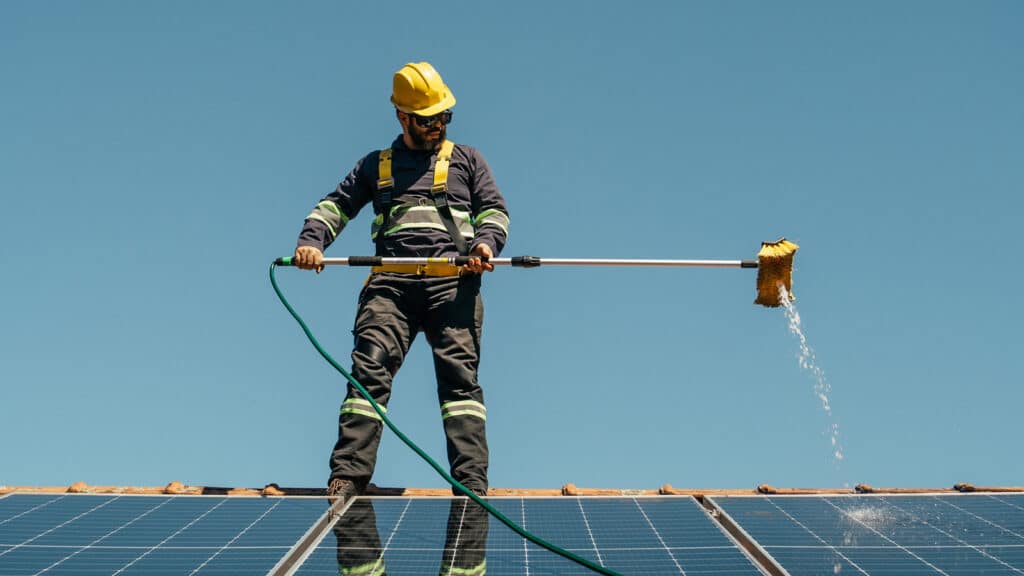
Taking care of your residential solar energy system is important if you want to keep your panels in top working shape and enjoy a high return on investment. In this guide, Triton Roofing & Solar outlines what residential solar panel maintenance looks like in Colorado Springs, including cleaning needs, maintenance requirements, local codes and incentives, and expected return on investment.
General Maintenance Requirements
How long do residential solar panels typically last?
The typical residential solar panel is made to last 25 to 30 years and keep working well. They lose a small portion of their capacity each year—about 0.5%—but the panels we install at Triton Roofing & Solar are built to last well into the third decade of use and generate a good amount of energy.
How often should a homeowner schedule professional maintenance?
It’s recommended to arrange a professional inspection once a year to monitor your solar system’s health. This involves:
- a visual check to assess any physical damage
- a review of wiring connections
- measurement of performance levels
A yearly inspection will also detect and address any minor issues before they develop into costly repairs.
Which residential solar components require routine maintenance?
A residential solar panel installation involves several key components, but you’ll generally focus on the solar panels themselves, the inverters, and the mounts that hold the panels in place. The panels produce energy, the inverter turns it into AC power usable in the home, and the mounts keep the system secured. All you need to do is be sure everything is installed correctly and kept up to the manufacturer’s specifications.
Cleaning Procedures
How often do solar panels need cleaning in Colorado Springs?
Solar panel owners here generally need to wash their panels a couple of times per year. Because our weather is generally dry for much of the year, dust, pollen, and other debris tend to build up on the panels’ surfaces, compromising their output. During the warmer, drier months, you’ll need to decide whether it is time to rinse your solar panels. However, snow and rain can be helpful during the winter months because they can help clear dust and pollen off the panels.
What is the proper and effective way to clean a solar panel?
The safest way to clean solar panels is with a soft-bristle brush, a squeegee, and non-abrasive soap mixed with water. You should avoid:
- high-powered washing machines
- harsh chemicals
- abrasive materials like steel wool and sponges, as they can damage the panel’s protective glass
You can also clean solar panels with just water from a standard garden hose if they are not too dirty.
How much of an impact do dust and pollen have on energy generation?
When dust, pollen, or other environmental particles build up on your solar panels, energy production can fall by five to 10 percent. While seemingly small, this reduction in efficiency is cumulative and affects your total yearly savings. Cleaning your solar panels ensures optimal energy generation by clearing obstructions that block sunlight from reaching them.
Should I clean my solar panels myself or call a professional?
Many homeowners can safely clean low-slope panels or ground-mounted arrays with proper safety measures in place. However, it’s safest to hire a professional for solar panel cleaning on second-story roofs or on steeper-pitched roofs. Professional crews will come equipped with harnesses, tools specifically made to clean PV panels, and insurance policies.
Seasonal Considerations and Weather Factors
How do heavy snows impact the structural capacity and performance of PV modules?
Solar modules are engineered and tested to endure significant weights. As such, Colorado’s snowy months, even in higher-elevation areas, are not usually a cause for concern. Snow is, of course, a major hindrance to energy production. Still, because solar panels are usually black, they absorb sunlight and heat up, which causes snow to melt and slide off more quickly than it does from other roofing materials.
What is the protocol for clearing snow and ice from rooftop solar installations?
- Generally, the best advice is to allow snow and ice to melt off. Attempting to clear off the panels increases the likelihood of either breaking the array or slipping off a roof.
- If the snow buildup is so great that it must be removed immediately to resume power generation, use a soft-foam roof rake.
- Never attempt to clear panels off with metal shovels or plastic scrapers.
How well do solar panels withstand severe hailstorms, such as those common in the Colorado Springs area?
High-quality solar panels are impact-resistant, built with tempered glass that resists hail up to an inch in diameter traveling at 50 miles per hour. While summer hailstorms can be common in the Colorado Springs area, they rarely cause any significant structural damage to a modern solar array. Furthermore, if a very large hail storm occurs, your solar panels provide an exceptional degree of structural support to your roof underneath them.
Does high-altitude increase UV exposure and accelerate panel degradation?
Colorado Springs is at a high altitude, so there is less atmosphere for the sun’s rays to pass through to reach your panels. This results in high energy production rates, but also higher exposure to UV rays. However, the materials used in solar panels are designed to resist UV degradation. The panels will degrade very quickly due to this intense amount of sunlight, yes. But this won’t significantly affect the rate of degradation. The warranty you are reading about covers the “normal” degradation expected from these panels.
Maintenance Costs and Financial Expectations
What are the average annual maintenance costs for a residential solar system in this area?
Annual maintenance costs for residential solar systems in our region are very low, typically $150- $300 per year. This usually includes an annual maintenance call with an inspection, and if needed, a professional panel clean. Because solar systems contain no moving parts, very little mechanical repair is necessary compared with other home utilities.
What type of maintenance and component repair or replacement is usually included in a typical manufacturer’s warranty?
- Standard manufacturer warranties cover what’s known as premature degradation, meaning the panel’s output falls below a specified percentage after the initial year.
- These warranties also cover physical manufacturing defects in materials or workmanship. A standard system will fail because one of the panels has a manufacturing defect and stops producing.
- A manufacturer will typically replace the defective panels, and Triton Roofing & Solar’s labor warranties should cover the labor to install the new units. Normal wear and tear, dirt, or weather damage are not covered.
How long before the system inverter needs to be replaced, and what is the typical cost?
Most residential rooftop solar panels are guaranteed to be efficient for twenty-five years or more. Most solar systems contain what are called standard “string” inverters. These usually have a lifespan of 10-15 years. Because the panels are guaranteed for a much longer lifespan, these systems typically require inverter replacements over time. You can anticipate the cost of a string inverter replacement to be about $1,000-$2,000. Micro-inverters generally last much longer and are frequently warranted for 25 years or more.
What type of insurance considerations are required for weather or other environmental damage?
- Solar arrays on rooftops are typically considered permanent structural components of the house, and most homeowner’s insurance policies cover damage to permanent structures.
- It is advisable to inform your insurance provider of new solar installations immediately after your panels are installed, so your coverage amount can be adjusted to reflect the increase in your home’s value resulting from the solar addition. This will provide protection should a severe weather damage event occur.
Local Regulations and Compliance
What are the local municipal codes for Solar Panel Maintenance in Colorado Springs?
Any significant repairs, structural modifications, or additions to an existing solar system must comply with current local codes published by the Pikes Peak Regional Building Department. Some regular repairs or maintenance, such as panel cleaning or replacing a faulty micro-inverter with one of the same make and model, are generally exempt from code requirements. Triton Roofing & Solar manages the code compliance checks for code-required repairs and major work on any system we have designed, installed, or maintained.
How do Homeowner Association regulations address the maintenance schedule and visibility of rooftop solar panels in my neighborhood?
- Colorado does not have a state law that would allow an HOA to entirely prohibit the installation of solar panels or require them to be installed in a way that would significantly reduce system output or increase installation costs.
- HOAs are allowed, however, to require that arrays be maintained in good repair, that visible debris be cleared from panels, and that repairs be made within a reasonable time. You should look up your specific neighborhood restrictions to ensure you are complying with all community maintenance requirements.
Does El Paso County require secondary permits for large repairs or upgrades?
- If the mounting system is being replaced completely, an inverter is being upgraded to a larger model, or more panels are being added to the array, secondary electrical and building permits are required.
- Secondary permits are not required for maintenance, warranty replacements, or system troubleshooting.
- If your system needs an authorized major repair, let us handle all permit processing.
Performance Monitoring and Troubleshooting
How do system owners track energy production?
Energy production is monitored via the proprietary Triton Roofing & Solar mobile application or web-based system connected to your home inverter. Monitoring software provides daily energy generation and seasonal data as well as individual panel production levels. You are encouraged to track your production baseline over time.
What performance issues signal that maintenance is required?
- A sudden, unexplained 20 percent or greater decrease in solar energy production on a clear, bright day suggests a system issue that warrants investigation.
- A gradual decline in energy production over several months is expected and could mean that it is time to have the solar array cleaned, or it could be a function of the changing seasons.
- A sudden, sharp decline in energy production may indicate a tripped circuit breaker, inverter failure, or damaged solar components.
- Regularly monitoring solar panel performance allows owners to spot drops in energy production right away.
How are inverter errors diagnosed and resolved?
Inverters have fault screens that indicate the type of error and provide an error code. Use the system manual to cross-reference your inverter error screen and determine whether the fault can be reset or requires further intervention. If the inverter issue is not resolved, or an unresolvable error persists after a reset, please contact Triton Roofing & Solar so that one of our technicians can diagnose and repair your system.
Need Professional Solar Maintenance?
Triton Roofing & Solar maintains your system as part of our commitment to helping our customers maximize the productivity of their solar energy systems. Please contact our office in Colorado Springs to schedule a system inspection, arrange maintenance service, or to request more information on protecting your investment in clean energy.